
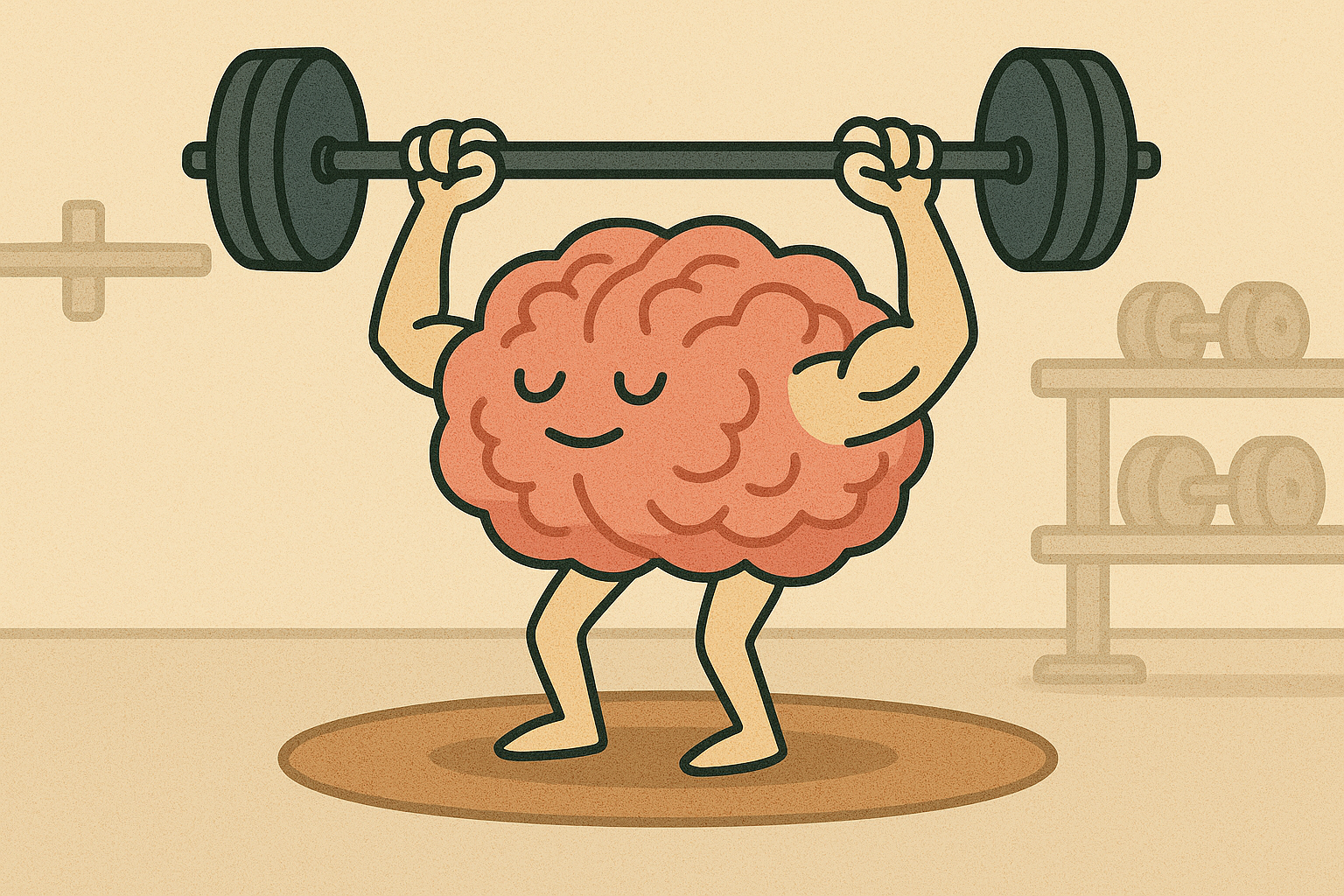
Think of that one thing you really want to get better at. Maybe it’s your fitness, your studies, or even your confidence. While talent decides your starting point, mindset is the multiplier for improvement, helping us to overcome obstacles and break down the mental barriers we build for ourselves.

This guide is about developing that mindset – specifically a growth mindset – to allow you to improve faster in anything you set your mind to. It’s built from notes and lessons I’ve learned myself, I hope you find it useful. Enjoy.
Understanding Growth Mindset
What is a Growth Mindset?
‘Growth mindset’ is a term coined by the psychologist Dr. Carol Dweck, and is the belief that your abilities can be developed through effort.
This contrasts a fixed mindset, which is the belief that your abilities are set in stone, and that if you can’t do something now, you’ll never be able to do it.
Fixed Mindset
- Abilities are fixed
- Challenges should be avoided
- Failure is proof of inability
Growth Mindset
- Everything is achievable with enough effort
- Challenges are opportunities
- Failure is a learning lesson
You’ve most likely already put yourself into one of the above categories already, but it’s important to realise that you probably have a degree of a growth mindset in some areas of your life and a fixed one in others.
Dweck’s work shows that shifting further towards a growth mindset allows us to improve faster and ultimately leads to better outcomes.
What are the Benefits of a Growth Mindset?
Improve Faster
Having a growth mindset involves embracing challenge and failure and learning from them. Think of it like this:
Challenge & failure -> learning -> improvement -> challenge & failure -> …
The more you can put yourself in this loop, the faster you’ll improve.
Compare this to a fixed mindset: a fixed mindset avoids challenge and failure, therefore never learns, therefore never improves.
Better Relationship with Yourself
We are our own biggest critic, especially with things that we want to be good at but aren’t (yet). By consciously shifting to having a growth mindset, we can view these situations more positively – enjoying and embracing the process, the effort, and the learning curve.
This shifts our natural internal dialogue to a much healthier place, rather than “I can’t”, or “I’m not good enough”. It also makes us more naturally confident because we’re not afraid of challenges or failing.
Better Outcomes
We should all have goals, things to aim for and work towards. Without a growth mindset, those goals can feel out of reach, and you end up shrinking your ambitions to something more comfortable. This is a great way to never reach your potential.
A growth mindset flips that and allows you to set goals that stretch you, because you understand that mindset is the multiplier of talent and effort is the driver of success. When you think like that, you aim higher, stay in the game longer, and end up reaching better outcomes than you ever would with a fixed mindset.
How to Develop a Growth Mindset
This section will cover the actionable steps you need to take in order to develop a growth mindset. They are all reframes – a reframe is when you consciously change the way you interpret something. In this case, we want to change the way we interpret comfort, effort, stress, and failure to see them through the lens of a growth mindset, rather than a fixed one.
Build Awareness of Your Current Mindset
Think back to the thing you thought of in the intro (the skill you want to develop or the goal you want to reach). Now look at how you approach it.
How do you react to setbacks? Do you lean into the process, the learning, the ‘grind’, or do you long for the end result? What’s usually behind your failures – lack of effort, lack of belief, or lack of consistency? And when you set goals, are they ambitious or comfortable?
Pair these questions with what you now understand about growth mindset. You’ll quickly see where your mindset is helping you achieve and where you need to develop it further.
Repeat this for other areas of your life and note where development is needed.
Another good exercise to keep in mind day-to-day is to notice where you avoid challenge. Situations where you know something needs to be done, but you opt to stay in your comfort zone rather than stretch yourself. This usually comes with a little voice in your head that makes a couple of excuses. Note these areas down as well.
Improve Your Relationship with Comfort
The comfort zone is the enemy of improvement. It’s also the easiest place to live because it requires no extra effort – it’s your default.
Think of it in fitness terms. To grow a muscle, you slowly increase the weight or reps over time. If you lift the same weight forever, your body has no reason to adapt.
Apply this principle to other areas in life. Start noticing when you’re choosing comfort even though you know you could stretch yourself a little: the extra rep, the work you’re avoiding, the slightly bigger challenge. That’s the growth zone, the area just outside your comfort zone, where you’re stretched but not overwhelmed.
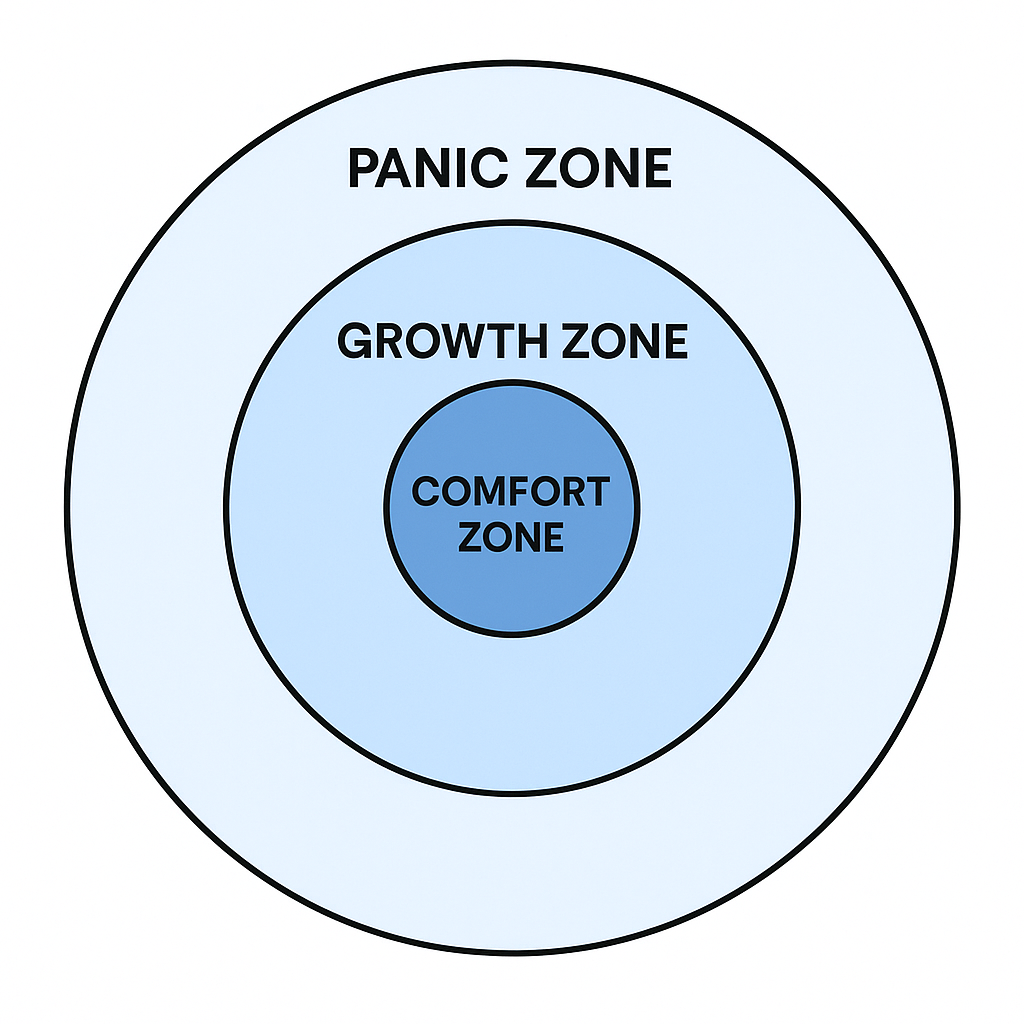
Avoid the panic zone. This is where you go too far, too fast – the equivalent of trying to lift double your personal best in the gym. No improvement happens here.
Fun example. You’re an introvert trying to become more confident talking to strangers. You step into a shop, pick up a pack of chewing gum, and walk over to the nice lady at the counter to pay.
Nice lady: “Hey, would you like a bag?”
Comfort zone: “No, thanks”
Growth zone: “No, thanks. How’s your day going?”
Panic zone: “No, thanks. Would you like to get a coffee with me after your shift?”
While there’s nothing wrong with suggesting a coffee, this is too big a jump for someone just starting to talk to strangers. Stretch yourself gently and consistently, you’ll improve far faster.
Improve Your Relationship with Effort
Talent might decide your starting point, but effort decides your trajectory.
Praising effort and not ability consistently leads to better outcomes in others. Kids who are praised for being clever avoid challenges. Kids praised for working hard take them on. Apply the same principle to yourself. Instead of taking pride in being naturally good at something, take pride in showing up, learning, and pushing yourself.
Effort (applied in the right direction) is the main driver of success, and this is a key reframe for a growth mindset. You can’t guarantee success by trying hard, but you can guarantee failure by not trying at all.
Improve Your Relationship with Stress
Stress gets a bad reputation, but not all stress is harmful. In fact, your mindset towards stress directly affects your body’s response to it.
Research (highlighted by Dr. Andrew Huberman, link in notes) shows that when people view stress is enhancing, their bodies shift toward a more performance-oriented stress response. When they view believe stress as harmful, the opposite happens and performance is negatively affected.
So a key reframe in developing a growth mindset is recognising that short bursts of stress are useful. Stress helps mobilise resources in the body, improves focus, helps us think clearly, and increases blood flow to the brain and muscles – all things that help you perform.
Why is this important? As mentioned, part of having a growth mindset is stepping out of your comfort zone and stretching your abilities. This can be stressful! This reframe is a way to deal with that stress and use it to your advantage.
There’s still an important distinction. Productive stress is short-term and challenge-based, the kind you feel before a workout, presentation, or trying something new. Chronic stress is constant, overwhelming, and interferes with sleep, mood, and health. Lean into productive stress, avoid chronic stress.
Improve Your Relationship with Failure
Every time something doesn’t work, you gain a data point on why it fails. That information is priceless as it shows you what to fix, change, or try next.
Treat feedback the same way. A fixed mindset avoids or disregards feedback as they ‘didn’t ask for it’, or ‘it doesn’t apply to them’. A growth mindset considers all feedback with an open mind and finds how it can help them improve.
Failing fast is a core part of a growth mindset because it means you’re taking action, testing ideas, and quickly ruling out what doesn’t work. This hones you in on what does work far faster than sitting still out of fear of failing. When you stop seeing failure as something to avoid and start seeing it as something to learn from, improvement becomes a much quicker process.
Final Thoughts
No one applies growth mindset perfectly in every part of life. There’s always something we’re scared of, a challenge we put off, a goal that looks bigger than we’re ready for.
If this guide has done its job, you should feel more equipped to lean into effort, use the stress as fuel, collect the data points, and stop drawing mental lines for yourself.
Last little tip: tell yourself you love it. Appreciate and be grateful for the challenge, the failures, the stress, because it means you’re moving forward.
Notes
Notes
- When was the last time you deliberately did something you knew you weren’t good at?
- Do you value looking smart, or do you value learning – especially when it makes you look bad at first?
- What’s your first reaction when someone outperforms you?
- Do you feel relief when you don’t have to push yourself? Or do you seek out challenges?
- When was the last time you changed your mind about something important?
- What’s one limiting belief you have about yourself that might not actually be true?
- How do you react when someone gives you constructive criticism?
- What skill or habit do you admire in others but tell yourself you “just don’t have”?
- If you had to teach someone your biggest weakness, how would you approach it?
I used to always moan when I was younger and I had to study. I’d go to my Dad “I just can’t do it!”. My Dad wouldn’t give any help, he’d just go “…Yet”. It used to drive me mental, but I guess he was onto something.
Further Reading & Sources
Start from 55:30 for info on stress is enhancing mindset
Studies mentioned were from Crum, Salovey & Achor, 2013 https://psycnet.apa.org/record/2013-06053-001
The OG
More on how to instil growth mindset in others.

br50at
w8qudt